
The History of the Leaning Tower of Pisa
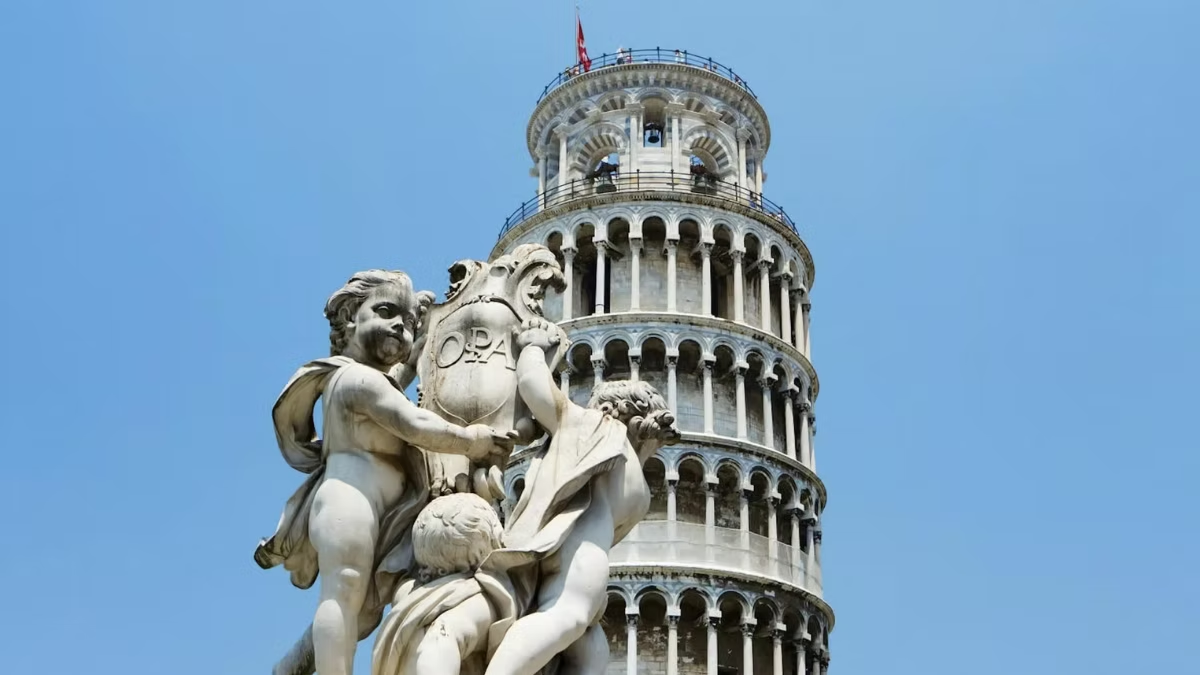
Construction of the Leaning Tower of Pisa began on 9 August 1173 and was completed in 1372 — nearly 200 years later. The Tower started leaning during the second phase of construction in 1178 due to soft, unstable soil on one side of the foundation. Three long construction pauses caused by medieval wars between Italian city-states inadvertently gave the soil time to consolidate, almost certainly saving the Tower from collapse. Between 1993 and 2001, engineers removed soil from beneath the high side of the foundation, reducing the lean from 5.5 degrees to a stable 3.97 degrees.
The story of the Leaning Tower of Pisa is one of the most remarkable in architectural history — not because it was built perfectly, but because it survived centuries of imperfection, near-collapse, misguided interventions, and eventually a €30 million engineering project that pulled it back from the edge of disaster. What began as an accident became an icon.
Origins: Pisa at the Height of Its Power
The Tower was built as the bell tower of Pisa’s Cathedral complex — a declaration of the city’s power after its naval victory over Arab forces in 1063. Construction was funded by war spoils. The foundation was laid on 9 August 1173.
To understand why the Tower was built, it is necessary to understand medieval Pisa. In the 11th and 12th centuries, Pisa was one of the four great Maritime Republics of Italy — alongside Venice, Genoa, and Amalfi — and one of the most powerful naval and commercial forces in the Mediterranean. In 1063, Pisan forces successfully attacked Palermo in Sicily and returned with an enormous quantity of treasure and spoils. This wealth funded an extraordinary ambition: the construction of a complete monumental religious complex that would announce Pisa’s power and piety to the world.
The complex — Piazza dei Miracoli, the Field of Miracles — was to include a cathedral, a baptistery, and a freestanding bell tower (campanile). The Cathedral had been begun in 1063 and consecrated in 1118. The Baptistery was started in 1152. The Tower was to be the final crowning element.
On 5 January 1172, Donna Berta di Bernardo, a widow, bequeathed sixty soldi to the Opera Campanilis petrarum Sancte Marie — the works committee for the bell tower. These funds were used to purchase stones that still form part of the Tower’s base today. On 9 August 1173, the foundations were formally laid and construction began.
The Architect: A Question Without a Definitive Answer
The identity of the Tower’s original architect remains one of architecture’s unresolved debates. The design was long attributed to Bonanno Pisano, a well-known 12th-century Pisan sculptor and bronze caster. A piece of cast metal bearing his name was discovered at the Tower’s base in 1820, though this may relate to the bronze doors of the Cathedral rather than the Tower itself.
A 2001 academic study suggested the architect was more likely Diotisalvi, based on stylistic affinities with other Pisan buildings he designed — notably the bell tower of San Nicola and the Baptistery. Giorgio Vasari, writing in the 16th century, credited Guglielmo and Bonanno Pisano jointly. The true answer remains uncertain.
Stage One: Construction Begins and the Lean Appears (1173–1178)
Construction began in 1173 and reached three storeys by 1178 — when the lean became visible. The soft, unstable soil on the south side of the foundation settled faster than the north, tilting the tower. Construction halted.
Construction progressed rapidly through the ground floor and second storey. The ground floor is a blind arcade of columns with classical Corinthian capitals in white marble — characteristic of the Pisan Romanesque style. But by the time construction reached the third floor in 1178, something had gone wrong.
The foundation had been laid on soil described as a mix of clay, fine sand, and shells — soft, compressible, and uneven. On the south side, the ground was marginally softer than on the north. As the tower’s mass increased with each floor, the south side began to sink more rapidly than the north. The Tower started to tilt southward.
Construction halted. The engineers had no solution. And then, fatefully, the Republic of Pisa went to war.
The Wars That Saved the Tower
A 94-year construction pause (1178–1272), forced by wars between Italian city-states, gave the soft soil time to consolidate under the tower’s weight. Engineers concluded this pause almost certainly prevented the incomplete tower from toppling.
Between 1178 and 1272 — nearly a century — the Tower stood incomplete at three storeys. Pisa was almost continuously at war with Genoa, Lucca, and Florence, and the resources and attention required for such an ambitious building project could not be sustained.
This enforced pause turned out to be the Tower’s salvation. As the incomplete structure sat undisturbed, the soft soil beneath the foundations gradually compressed and consolidated under its weight. Engineers who studied the Tower in the 20th century concluded with near-certainty that had construction continued without interruption, the Tower would have toppled before it was finished. The wars, unintentionally, stabilised it.
Stage Two: Resumption and the Curve (1272–1284)
Construction resumed in 1272 under the master builder Giovanni di Simone, architect of the Camposanto Monumentale. Di Simone recognised the lean and attempted to compensate for it by building the upper floors with one side slightly taller than the other — essentially tilting the new construction in the opposite direction to the lean. The result was that while the Tower continued to lean, its upper sections bent slightly in compensation, giving it the subtle banana-shape curve that careful observation reveals today.
By 1278, Di Simone had brought the Tower from three to seven storeys. Then construction halted again — this time because the Pisans were defeated by the Genoese at the Battle of Meloria in 1284, a catastrophic naval defeat that marked the beginning of Pisa’s decline as a maritime power.
Stage Three: Completion (1319–1372)
The seventh floor was completed in 1319. The bell chamber — the crowning belfry — was finally added between 1350 and 1372 by the architect Tommaso di Andrea Pisano. Tommaso succeeded in harmonising the Gothic elements of the belfry with the Romanesque style of the lower eight storeys, and the Tower was declared complete approximately 199 years after its foundations were laid.
Seven bells were installed in the belfry, one for each note of the musical major scale. Their names are Assunta (the largest, installed in 1655 and weighing 2.5 tonnes), Crocifisso, San Ranieri, Dal Pozzo, Pasquareccia (the oldest, cast in 1262), Terza, and Vespruccio. The bells sounded before Cathedral masses for centuries.
At completion, the Tower leaned at approximately 1.4 degrees. It would continue to lean further over the following centuries.
Galileo and the Tower: Legend and Reality
The most famous story associated with the Tower is that Galileo Galilei dropped two cannonballs of different masses from the belfry gallery between 1589 and 1592 to demonstrate that objects fall at the same rate regardless of weight — a direct challenge to Aristotle’s prevailing teaching.
Galileo was born in Pisa in 1564 and later taught at the University of Pisa, so the setting is plausible. However, this experiment appears in accounts written after his death — most notably by his student Vincenzo Viviani — rather than in Galileo’s own writings. Most historians consider the Tower experiment a legend, or at best an embellishment of experiments he certainly did conduct (though likely not from this building). The story is almost certainly more symbol than history.
What is historically documented is that Galileo used the Cathedral’s hanging lamp — visible in the nave today — to study pendulum motion, observing that regardless of the amplitude of a swing, the period remained constant.
The Growing Lean: 17th–20th Centuries
After completion, the Tower’s tilt continued to increase slowly. By 1298 the lean had been measured at 1.43 metres off perpendicular; by 60 years later it had reached 1.63 metres. The lean was increasing at a rate of approximately 1–1.2 millimetres per year.
A series of well-intentioned interventions over the centuries made things worse. In 1838, architect Alessandro Gherardesca excavated a pathway around the Tower’s base to expose its ornately carved lower section — which had been buried by centuries of soil accumulation. The excavation destabilised the foundation and caused a sudden increase in the lean. By 1918, the plumb deviation had reached 5.1 metres.
In the 1930s, Benito Mussolini — who considered the lean an embarrassment to Italy — ordered the Tower to be straightened. Workers injected 90 tonnes of concrete into the foundation on the low side. The result was the opposite of intended: the Tower lurched further in the direction of its lean. By 1990, the tilt had reached 5.5 degrees — the most extreme in the Tower’s history.
The 1990 Crisis and Modern Stabilisation
By 1990, the lean had reached 5.5 degrees and the Tower was closed. Between 1993 and 2001, engineers extracted 38 cubic metres of soil from beneath the north (high) side of the foundation, reducing the lean to 3.97 degrees. The Tower was declared safe and reopened in 2001.
In 1989, the Civic Tower of Pavia — a medieval structure with similar structural challenges — collapsed without warning, killing four people. The following year, the Italian government closed the Leaning Tower of Pisa to the public amid genuine fears of imminent collapse.
A team of 16 international engineers was assembled to find a solution. The challenge was unique: the Tower had to be stabilised without being straightened. The lean was the reason 5 million visitors came each year. Returning the Tower to vertical would destroy its identity.
The solution, developed and implemented between 1993 and 2001, involved carefully extracting soil from beneath the north (high) side of the foundation. By removing approximately 38 cubic metres of earth from the side away from the lean, engineers allowed the Tower to settle back slightly toward vertical — reducing the lean from 5.5 degrees to 3.97 degrees, equivalent to the tilt of approximately 200 years earlier. Steel cables and lead counterweights provided temporary stabilisation during the most delicate phases of the work.
The Tower was declared safe and reopened to the public in 2001. Engineers estimated it would remain stable for at least 200–300 years without further intervention.
Ongoing Monitoring
After reopening, the Tower continued to be monitored closely. Engineers observed that the Tower was actually very slowly recovering further — moving back toward vertical by small fractions each year — a natural consequence of the soil stabilisation from the 1993–2001 work. By 2013, the Tower had recovered an additional 2.5 centimetres of lean since the stabilisation was completed, confirming that the soil consolidation process was continuing as predicted.
The Tower remains one of the most studied structures in the world from a geotechnical engineering perspective. Its behaviour — particularly its remarkable survival of multiple strong regional earthquakes since 1280 — has contributed significantly to the understanding of soil-structure interaction in seismic conditions.
A Brief Historical Timeline
| Year | Event |
|---|---|
| 1063 | Pisan forces attack Palermo; treasure funds monumental complex |
| 1152 | Baptistery construction begins |
| 1172 | Donna Berta di Bernardo bequeaths funds for the bell tower |
| 1173 | Tower foundations laid; construction begins |
| 1178 | Lean becomes apparent after third floor; construction pauses |
| 1233 | Construction resumes |
| 1272 | Second major construction phase begins under Giovanni di Simone |
| 1284 | Construction halted after Battle of Meloria |
| 1319 | Seventh floor completed |
| 1372 | Bell chamber added; Tower declared complete |
| 1589–92 | Galileo’s experiments (likely apocryphal) |
| 1655 | Largest bell, Assunta, installed |
| 1838 | Gherardesca excavation worsens the lean |
| 1934 | Mussolini’s concrete injection further increases lean |
| 1987 | UNESCO World Heritage Site designation |
| 1990 | Tower closes to public; tilt at 5.5 degrees |
| 1993–2001 | Soil extraction stabilisation project |
| 2001 | Tower reopens; lean reduced to 3.97 degrees |
Frequently Asked Questions
When was the Leaning Tower of Pisa built?
Construction began on 9 August 1173 and was completed in 1372 — approximately 199 years later. The long construction period was caused by three major interruptions due to wars between Italian city-states.
Who built the Leaning Tower of Pisa?
The identity of the original architect is debated. The main candidates are Bonanno Pisano (traditional attribution), Diotisalvi (favoured by a 2001 study), and Guglielmo (cited by Giorgio Vasari). Giovanni di Simone directed the second construction phase; Tommaso di Andrea Pisano completed the belfry.
When did the Tower start leaning?
During the construction of the third floor in 1178 — just five years after foundations were laid. The soft soil on the south side of the foundation could not support the growing weight of the structure evenly.
Was the lean intentional?
No. The lean was an unintended consequence of building on unstable soil. The design was always for a straight, vertical tower. However, the builders’ attempts to compensate for the lean by adjusting upper floors created the subtle curve visible today.
How much does the Tower lean?
Currently 3.97 degrees, or approximately 3.9 metres off vertical at the top. Before the 1993–2001 stabilisation project, it leaned at 5.5 degrees — the most extreme tilt in its history.
Is the Tower still leaning?
Yes — and always will be. The goal of the modern stabilisation was to reduce the lean to a safe angle, not eliminate it. The Tower now leans at 3.97 degrees and is considered stable for the next 200–300 years.
